The Pyramid Principle — Barbara Minto
Using this book, I wrote my Bachelor and Master theses in 24 hours and 3 days respectively, achieving top grades. Although it gives concrete writing advice, I read it as a book about the structure of thought.
Barbara Minto raises three important points about business writing:
- Start with the answer first.
- Group your arguments in bunches of three.
- Logically order your supporting ideas (by time, structure, or degree).
In her explanation of point (2), she introduces a hierarchical structure of thought, which she calls pyramids.
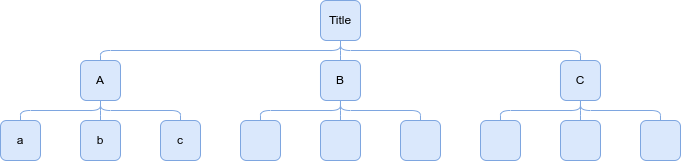
Any piece of writing is split into three sections A, B and C, and each section into three paragraphs a, b and c. The leaf nodes of the pyramid contain concrete points and arguments. One recursively traverses the pyramid from the top, going downwards and left to right, writing about the content of each node:
Title → A → a → b → c → B …
This practice ensures that the main points and their supporting arguments are well structured. I found that I almost never need to rewrite sections anymore, because the writing has been structured ahead of time. Preparing this way let me accumulate results and arguments in very large trees with >80 leaf nodes. While collecting material I often restructure the pyramid to align with what I found. This explains the speed at which I can write: with a clear structure of thought and all the material collected, writing is just formulating a sentence for every leaf node — the hard structural work is already done.
The Pyramid Principle is written from the perspective of business reports at McKinsey, so the strict law of threes applies. For my theses I softened this rule to fit the natural structure of the argument, allowing more child nodes. If there are five important supports to a claim, why not write all of them?
To represent pyramids I use an open-source tool called Freeplane. It isn't pretty, but it supports everything I need: node editing, collapsing, summary nodes and notes. I fully expect to write my PhD thesis with it (although maybe not in 24 hours).
TLDR:
- Knowledge is hierarchical.
- Accumulating it in a pyramid provides hierarchical structure.
- Writing out the branches of the pyramid is easy.